
Imagine standing on a busy street corner at eight in the morning, holding a paper plate that is already turning soft from the oil. Thinking to yourself, right here might be the best thing you eat all year.
This is what a morning in Jaipur can do for you.
A morning in Jaipur can start with something as simple as a hot kachori from a busy street stall, and suddenly, food becomes one of the best parts of the trip.
The old markets, pink walls, and forts are what you’re in Jaipur for. The hardest thing to leave without is the memory of the food.
From the dishes not to be missed to where to find them and how to eat them like a local, this is your guide.
Why Jaipur’s Street Food Feels Different
Rajasthani cuisine developed around the region’s climate, available ingredients, preservation techniques, dairy, grains, and spices.
You can see signs of historical influences in every dish, as well as the availability of ingredients and specific techniques used.
Jaipur’s street food scene is predominantly vegetarian, with Jain and Marwari food traditions influencing many local dishes.
Many popular street-food spots in Jaipur’s old city are vegetarian-focused, with kachoris, chaats, sweets, and other snacks being especially common, and yet you will not be disappointed by the lack of variety.
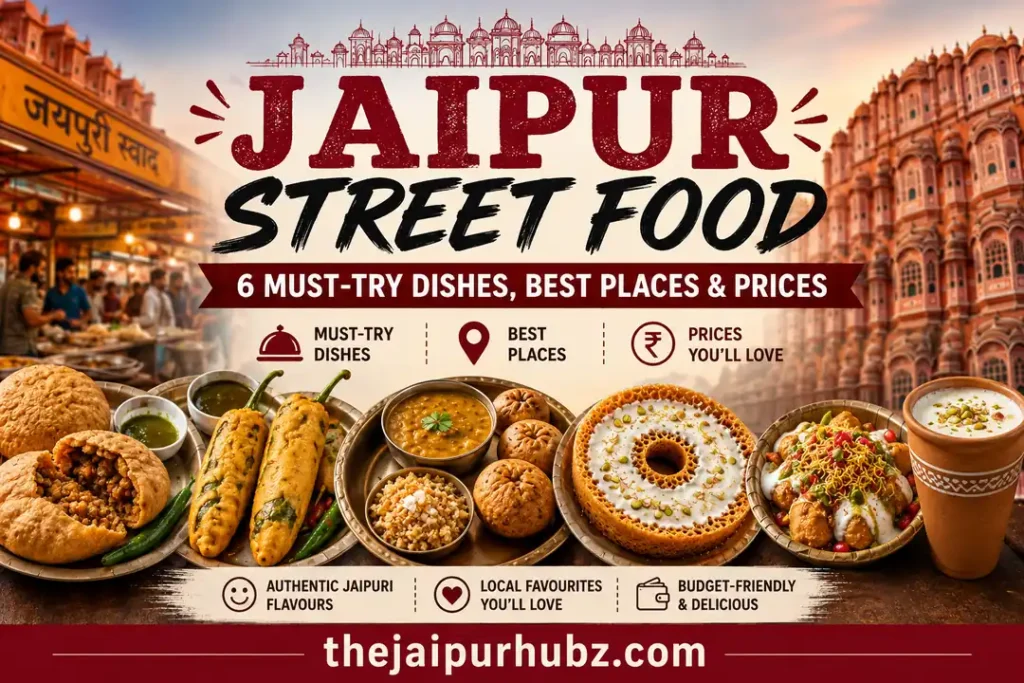
Now that we have explored the context of Jaipur cuisine, let us take a closer look at the dishes. Below is a quick list of the dishes you should not miss.
| Dish | What It Is | Best Known Spot | Approx Price |
| Pyaaz Kachori | Deep-fried pastry stuffed with spiced onion | Rawat Mishthan Bhandar, MI Road | ₹45 to ₹60 |
| Mirchi Vada | Large green chilli stuffed with spiced potato, batter-fried | Rawat Mishthan Bhandar, old city stalls | ₹20 to ₹40 |
| Dal Baati Churma | Baked wheat balls with lentil curry and sweet crumble | Masala Chowk, local dhabas | ₹150 to ₹300 for a full plate |
| Ghewar | Honeycomb-textured sweet disc soaked in syrup | Laxmi Mishthan Bhandar (LMB), Johari Bazaar | ₹40 to ₹60 per piece |
| Kachori Chaat | Kachori topped with curd, chutneys, and spices | Samrat, Chaura Rasta | ₹40 to ₹70 |
| Lassi | Thick, creamy yogurt drink in a clay cup | Lassiwala, MI Road | ₹70 to ₹120 |
Prices at street stalls shift a little from season to season and shop to shop, so treat these as a starting estimate rather than a fixed number.
With that overview in hand, let us walk through each dish properly.
Why Jaipur Street Food Is So Unique
Pyaaz Kachori
You’ll find this on menus across Jaipur – and you’ll be glad of it. It is a deep-fried wheat-flour parcel with a spicy onion filling, and it has to be eaten hot – with tamarind or green chutney, preferably.
Crunch on the crisp shell to reveal a warm, peppery core that makes your eyes water. Rawat Mishthan Bhandar, near the railway station, has been around since the 1950s and is the place to go, say the locals, for authentic Jaipuri food.
From here, it is a short walk to the next item on the trail: another local specialty that has to be taken with caution.
Mirchi Vada
It looks almost as innocent as the pyaaz kachori, but the large green chillies stuffed with spiced potato and dipped in chickpea flour cannot hide their true nature.
Very hot, in fact, but you can ask for it to be “less spicy” if you have a delicate digestion.
It is best eaten with the sweet tamarind chutney that comes with the kachoris, as the dish lives up to its reputation as one of the spiciest street snacks around.
After sampling such a piquant plate, a heartier dish is in order – and here, Jaipur has something special.
You May Also Check: Best Restaurants in Jaipur: 22 Must-Try Places for Food Lovers
Dal Baati Churma
This combination of a flat, hard ball of wheat bread called baati, a rich lentil curry called dal, and a sweet, crumbly mixture of wheat, ghee, and jaggery called churma is substantial, but it has long been a local staple.
Eat the baati with your fingers, dip it into the dal, then add a helping of churma on top. It’s a mixture of savoury and sweet, but it all combines to make an utterly satisfying dish.
Having worked up an appetite, you’ll need something sweet to finish – and there is no sweeter sound in Jaipur than ghewar.
Ghewar
This traditional sweet, made of a flour disc with a honeycomb structure and bathed in syrup, is sometimes topped with a dollop of rich rabri (thickened cream).
It is associated with the festivals of Teej and Raksha Bandhan, but it can be found in most sweet shops, including the popular Laxmi Mishthan Bhandar in Johari Bazaar, which the locals will gladly recommend.
If you like the sound of the kachori chaat, here’s a treat that takes the idea of layered textures to a new level.
Kachori Chaat
This chaat is a mixture of savoury ingredients with tamarind, curd and spices – uses broken kachoris in a spiced curry and adds a dollop of cooling yoghurt on top.
A very satisfying start to a meal, this one comes highly recommended: it is impossible to eat it and not feel full.
Now, after all that, you’ll need something cold and refreshing to wash it all down – and there is no better drink in Jaipur than lassi.
Lassi at Lassiwala
On MI Road, just near Panch Batti, a small shop has been cooling the locals down since 1944 with this sweet, thick, and creamy yogurt-based drink.
It comes in clay cups with a big blob of malai (cream) on top – and there is no need to hurry when drinking it, as the locals will tell you.
There are other places in the city selling lassi, all using variations of the same name, so look out for the queues of eager customers.
Now that you have tasted some of Jaipur’s culinary delights, where should you go to sample more?
Where to Eat Your Way Through Jaipur
Instead of planning numerous excursions for each dish on your list (which would be utterly exhausting), note the places in the city that cover most of your required meals.
As you would need to walk up and down MI Road to include both the Rawat Mishthan Bhandar and the Lassiwala, you may want to save your energy for another day.
The old city, with its Bapu Bazaar and Johari Bazaar, is the place to go for kachoris, sweetmeats, and general shopping, as the labyrinthine streets give an illusion of timelessness.
Chandpole Bazaar and Tripolia Bazaar are best explored in the early morning, when the first tea stalls and sweet shops are opening their shutters.
On the other hand, if you are the type to want to sample everything on the menu without having to navigate the old city, your best bet is Masala Chowk inside the Ram Niwas Garden.
This collection of open-air stalls, set up around the Albert Hall Museum, offers a variety of local specialties and cuisine.
Now that you know where to go, here is a brief summary.
| Area | Known For | Best Time to Visit |
| MI Road | Pyaaz Kachori, Lassi, Kesaria Lassi | Morning to early afternoon |
| Bapu Bazaar | Kulfi, chaat, general market snacking | Late morning onward |
| Johari Bazaar and Old City Lanes | Kachoris, Ghewar, traditional mithai shops | Early morning |
| Chandpole and Tripolia Bazaar | Chai stalls, mithai shops | Early morning |
| Masala Chowk, Ram Niwas Garden | Wide variety in one place, family-friendly | Evening, around 6 to 9 pm |
Before you head out, a few small habits will make the whole experience smoother.
A Few Tips Before You Dive In
Eat where the locals eat, since a stall full of regulars rather than tourists is usually a sign the food is genuinely good.
Arrive early to sample fried treats (kachoris and vadas) as they taste best straight from the fryer.
Popular stalls sell out fast, so order early. Also bring some cash with you, as most street hawkers do not take cards.
Lastly, pace yourself because it is very easy to overeat here, leaving no room for dessert. At least leave some space for one last sweet treat before heading back.
When it comes to street food, a good rule of thumb for avoiding illness is to stick to busy places with fresh meals, as well as following the Centers for Disease Control and Prevention guidelines for food safety while traveling.
FAQs
What is the most famous street food in Jaipur?
The star attraction of street food in Jaipur is pyaaz kachori, a dish locals and visitors alike swear by.
It is a deep-fried pastry with onions inside that is preferably eaten warm with tamarind or mint chutney. The most popular address is Rawat Mishthan Bhandar, near the railway station.
Is street food in Jaipur primarily vegetarian?
Street food in Jaipur is predominantly vegetarian, and you have a high chance of getting delicious meat-free meals due to the local Jain and Marwari heritage.
Nevertheless, there are great meat options in Jaipur as well, particularly in areas like Raja Park.
Where can I taste various street food dishes in Jaipur?
In order to sample numerous local dishes, head to Masala Chowk, an open-air complex at Ram Niwas Garden, near the Albert Hall Museum.
Here, more than twenty different street food vendors sell their delicacies for a relatively small price, and this is a great opportunity to satisfy your taste buds without breaking your budget.
What time is best for exploring street food in Jaipur?
The best time to explore street food in Jaipur is in the morning, when most vendors open and the most popular places have a decent queue already. This is when the freshest and crispest kachoris and vadas are fried.
Is street food in Jaipur safe to eat?
Yes, it’s safe if you choose your stalls carefully. In this regard, it might be helpful to pay attention to other customers: if a specific street food vendor has a constant flow of clients, it is a sign that his food is up to standard.
What sweet dishes and drinks should I try in Jaipur?
Ghewar is a traditional Jaipur sweet, while lassi is a classic drink worth trying.
Ghewar is a typical dessert made of flour, which is shaped like a honeycomb, and it is popular with people of all ages, even though it is traditionally associated with festivals.
A Closing Thought
You will carry home the memories of forts captured through lenses, the memories of a meal savored in the form of warmth of good food eaten standing on a busy street, the sweetness of sugar clinging to your fingers after having relished a piece of ghewar, and the advice of a stranger standing next to you at the stall who knows your order better than you.
This is what Jaipur’s street food offers you: a glimpse into a slice of the city that you can remember forever.