
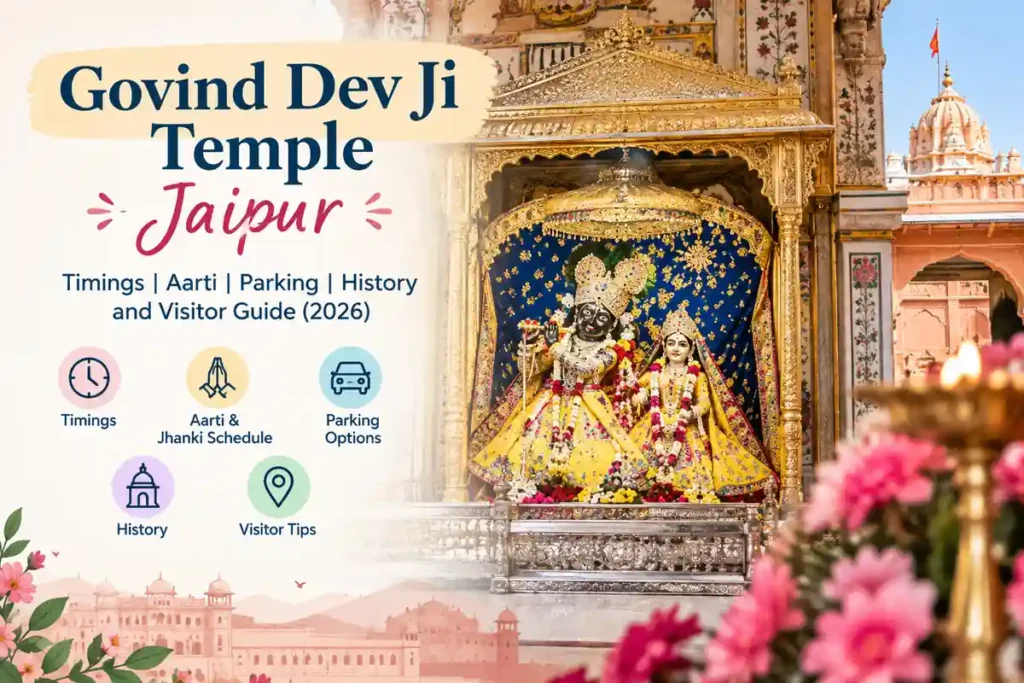

Planning a visit to Govind Dev Ji Temple in Jaipur? This famous Krishna temple is located in the City Palace area and is known for its royal history and seven daily darshan sessions, called jhankis. The temple’s general morning hours are 5:00 AM to 12:15 PM, while evening hours are 5:00 PM to 8:45 PM, according to its listed timings.
Individual darshan sessions take place at specific times, so checking the latest schedule before visiting is important. Entry is generally free.
This guide covers Govind Dev Ji Temple’s timings, aarti schedule, parking options and charges, history, and travel tips to help you plan your visit.
Govind Dev Ji Temple: Quick Details
| Visitor information | Details |
| Temple name | Govind Dev Ji Temple |
| Location | City Palace area, Jaipur, Rajasthan |
| Main deity | Lord Govind Dev Ji, a form of Lord Krishna |
| Entry fee | Generally free |
| Daily worship | Seven traditional jhankis |
| Nearby landmark | City Palace |
| Main festival | Janmashtami |
| Parking | Nearby street parking and parking facilities |
| Best planning tip | Check the darshan schedule before travelling |
Govind Dev Ji Temple Timings in 2026
The temple’s general visiting hours and its individual darshan sessions are different. General opening hours tell you when the temple is usually open, while jhanki timings tell you when the deity is available for darshan.
The general hours listed on Google Maps are:
| Day | Morning | Evening |
| Monday to Sunday | 5:00 AM–12:15 PM | 5:00 PM–8:45 PM |
These hours may change during festivals or special occasions. Visitors should confirm the schedule before travelling, particularly if they have a specific darshan in mind.
Govind Dev Ji Temple Aarti and Jhanki Schedule
The temple follows seven traditional worship sessions throughout the day. Each has a different place in the daily routine.
The following schedule was published for 6 September to 24 October 2026 by a third-party information website. It is a reference timetable, not an independently confirmed official schedule.
| Jhanki | Published timing | Significance |
| Mangla | 5:00 AM–5:15 AM | Early morning darshan |
| Dhoop | 7:45 AM–9:00 AM | Morning worship |
| Shringar | 9:30 AM–10:15 AM | Darshan after the deity is adorned |
| Rajbhog | 10:45 AM–11:15 AM | Worship associated with the main offering |
| Gwal | 5:00 PM–5:15 PM | Afternoon-to-evening worship |
| Sandhya | 5:45 PM–6:45 PM | Evening darshan |
| Shayan | 8:00 PM–8:15 PM | Final darshan before the deity rests |
Please note: This timetable ends on 24 October 2026. Do not rely on it for dates beyond that period without checking an updated schedule.
Which Darshan Should You Choose?
Your choice depends on how you want to plan the visit. Mangla is suitable for early risers, while Shringar and Rajbhog fall during the morning. Sandhya is an option for those who prefer an evening visit.
Try to arrive 15–30 minutes before your chosen session. This gives you time to manage traffic, find parking and reach the entrance without rushing.
You May Also Like: Galta Ji Temple Jaipur: Timings, Entry Fee, Photography Charges, History, and Visitor Guide (2026)
Govind Dev Ji Temple Parking: Locations and Charges
The temple is in Jaipur’s historic centre, where traffic and parking can become challenging during busy periods. Google Maps lists street parking in the surrounding area, but available spaces are not guaranteed.
Parking Options Near the Temple
| Parking option | Area | Important detail |
| Street parking | Roads around the temple and City Palace area | Follow signs and local restrictions |
| Parking Lot near Govind Dev Ji Mandir | Tulsi Marg, Gangori Bazaar area | Check availability on arrival |
| City Palace Parking Area | Gangori Bazaar area | Confirm access and walking distance |
| Aatish Market Parking | National Highway 11, Gangori Bazaar area | Check whether it suits your route |
| Other nearby parking facilities | Gangori Bazaar and the surrounding Pink City area | Charges and vehicle rules may differ |
These are mapped nearby options, not a guarantee of current availability. Follow traffic police instructions if access to the old city is restricted.
How Much Is Parking Near Govind Dev Ji Temple?
As of 13 October 2026, a current official rate card for normal-day parking near the temple could not be verified.
Some third-party travel guides mention an approximate ₹20–₹50 charge for car parking in the nearby City Palace area. This is only an estimate, not a confirmed current price. Two-wheelers may have different rates.
Before parking, ask the operator about the fee and whether it is hourly or for a longer period. During Janmashtami, special traffic and parking arrangements may apply, so check the Jaipur Traffic Police advisory.
Several Pink City hotels do, and our list of budget-friendly hotels in Jaipur is a good place to start
Is Entry Free at Govind Dev Ji Temple?
Darshan is generally free, and visitors do not normally need to purchase an admission ticket. However, parking and other optional services may involve separate charges.
If you are visiting during a major festival or a special event, check for any temporary arrangements before travelling.
History of Govind Dev Ji Temple
Govind Dev Ji Temple has a strong connection with Jaipur’s royal history. It stands in the City Palace area and is associated with Maharaja Sawai Jai Singh II, who founded Jaipur.
According to Rajasthan Tourism, the temple was built in 1735. Its history is closely linked to the worship of Lord Krishna and the religious traditions of Jaipur’s royal family.
Who Is Govind Dev Ji?
Govind Dev Ji is worshipped as a form of Lord Krishna. For devotees, the temple is a place to pray, attend darshan and take part in daily worship.
Religious traditions connect the deity with Vrindavan, one of the most important places associated with Krishna devotion. Stories about the deity’s origins form part of the temple’s devotional history and should be understood as religious tradition rather than independently established historical fact.
Why Is the Temple Important to Jaipur?
The temple’s royal association gives it a special place in the city’s history. Over time, it has also become an important centre of daily worship for local residents and visiting devotees.
Its importance comes from both sides: its historical link with Jaipur’s rulers and its continuing role in the city’s religious life.
Why Is Govind Dev Ji Temple Famous?
Three features help explain the temple’s importance.
Its daily jhankis: The seven worship sessions structure the day around different stages of devotion. Visitors often plan their trip around a particular session.
Its connection with Lord Krishna: Govind Dev Ji is the central deity, and devotees visit to offer prayers and seek blessings.
Its royal and festival traditions: The temple’s connection with Jaipur’s royal past and its Janmashtami celebrations make it an important destination for devotees. Festival days can be especially busy, so visitors should plan transport and arrival time carefully.
What to Expect During Your Visit
Govind Dev Ji Temple is primarily a place of worship, so the experience is different from visiting a palace or museum. Your visit will usually centre on darshan rather than exploring a large monument.
- A devotional setting: Expect worshippers, prayer and activity around the scheduled darshan sessions.
- Queues at busy times: Popular sessions, weekends and festivals may attract larger crowds.
- A historic-city location: Roads in the surrounding area can be congested, especially during peak hours.
- Temple rules: Follow instructions from temple staff and ask before taking photographs.
- A short visit or a longer wait: The time needed depends on the crowd and the darshan session you choose.
Wear comfortable, modest clothing and keep your belongings manageable. If you are visiting with children or older family members, allow extra time rather than planning a very tight schedule.
Govind Dev Ji Temple Compared With Other Krishna Temples
India has several important Krishna temples, each with its own traditions and religious significance. Govind Dev Ji Temple is distinctive for its Jaipur royal connection and its structured daily jhanki routine.
| Temple | Location | Distinctive feature |
| Govind Dev Ji Temple | Jaipur, Rajasthan | Royal history and seven daily darshan sessions |
| Banke Bihari Temple | Vrindavan, Uttar Pradesh | Distinctive darshan customs and a strong tradition of Krishna devotion |
| Dwarkadhish Temple | Dwarka, Gujarat | Major Krishna shrine associated with the religious traditions of Dwarka |
These temples are different in history, customs and devotional practice, so there is no single measure that makes one universally better than another. For someone visiting Jaipur, Govind Dev Ji Temple offers an opportunity to experience Krishna worship within the city’s historic royal setting.
Best Time to Visit Govind Dev Ji Temple
The best time depends on the darshan session you want to attend and how much time you have available.
- For morning worship: Choose a morning jhanki and confirm its latest timing.
- For an evening visit: Plan around the published evening sessions and allow for city traffic.
- For Janmashtami: Expect larger crowds and possible traffic diversions.
- For easier travel: An ordinary weekday may be more manageable than a major festival day, although crowds can still vary.
During Jaipur’s hotter months, plan your journey with the weather in mind. Carry water for the journey and follow the temple’s instructions about items that may be brought inside.
Dressing for both the weather and the temple matters, so see what to wear in Jaipur
Visitor Tips Before You Go
A little preparation can make the visit easier:
- Check the current jhanki schedule rather than relying only on general opening hours.
- Allow extra time for parking and walking to the temple.
- Confirm parking charges before leaving your vehicle.
- Follow the rules on photography and personal belongings.
- Check traffic advisories if visiting during a major festival.
- If mobility access is important, confirm current arrangements before travelling.
Frequently Asked Questions
1. What does “jhanki” mean at Govind Dev Ji Temple?
A jhanki is a scheduled opportunity for devotees to view the deity. The temple’s daily worship routine includes seven such sessions, each associated with a different part of the day.
2. Can I visit Govind Dev Ji Temple and City Palace on the same day?
Yes. They are both in Jaipur’s historic centre, so you can plan them for the same day. Check City Palace’s separate opening hours and ticket rules, and make sure its visiting schedule does not conflict with your chosen temple darshan.
3. How early should I arrive before darshan?
Arriving around 15–30 minutes before the session is a useful starting point. Allow more time on weekends, festival days or whenever traffic around the old city is heavy.
4. Is Govind Dev Ji Temple suitable for a family visit?
Families can visit the temple for darshan. If you are bringing young children or older relatives, plan for possible queues, keep belongings manageable and avoid scheduling other activities too tightly.
5. Are the temple’s timings the same throughout the year?
Not necessarily. General opening hours and individual jhanki times can change due to seasonal schedules, festivals or special arrangements. Check an updated timetable for your visit date.
6. What should I do if I arrive after a jhanki has ended?
Check the schedule for the next session instead of assuming the deity will remain available for viewing. If the timing is unclear, ask temple staff or consult the latest temple information.
7. Is Govind Dev Ji Temple mainly a tourist attraction or a place of worship?
It is an active place of worship. Visitors interested in its history are welcome to learn about its background, but they should respect the devotional atmosphere and follow temple instructions.
8. Does Janmashtami affect travel to the temple?
It can. Large crowds and special traffic arrangements may affect the route, drop-off points and parking. Check the Jaipur Traffic Police advisory before setting out on the festival day.
Conclusion
Govind Dev Ji Temple brings together Krishna devotion, Jaipur’s royal history and a daily worship routine built around seven jhankis. To make the most of your visit, choose a darshan session first, confirm its current timing and plan your transport around the busy City Palace area.
Parking charges are not reliably confirmed by an official current rate card, so check the price with the operator before leaving your vehicle. A little planning will help you spend less time managing logistics and more time enjoying your visit.
For more Famous temple places in Jaipur you can read this:
“Birla Mandir Jaipur timings, darshan and entry fee”: https://thejaipurhubz.com/birla-mandir-jaipur-timings/
“Kale Hanuman Ji Jaipur timings, aarti and history”: https://thejaipurhubz.com/kale-hanuman-ji-jaipur-timings/
“Akshardham Temple Jaipur timings and visitor guide”: https://thejaipurhubz.com/akshardham-temple-jaipur-timings/
“Akshaya Patra Temple Jaipur timings and visitor guide”: https://thejaipurhubz.com/akshaya-patra-temple-jaipur-timings/
Sources and Further Information
- Rajasthan Tourism: https://www.tourism.rajasthan.gov.in/content/rajasthan-tourism/en/tourist-destinations/govind-dev-temple.html
- Incredible India: https://www.incredibleindia.gov.in/en/rajasthan/jaipur/govind-dev-ji-temple
- Government of India Utsav Portal: https://www.utsav.gov.in/view-darshan/shree-govind-devji
- Temple darshan information: https://mandirshrigovinddevjijaipur.org/temple-govind-darshan/
- Temple contact page: https://mandirshrigovinddevjijaipur.org/contact/
- Additional visitor information: https://www.elephantvillageamer.com/blog/our-blog-1/govind-dev-ji-temple-jaipur-44
- Additional visitor guide: https://www.goldentriangletours.com/blog/govind-dev-ji-temple-jaipur-timings-aarti-visitor-guide#collapse2
- Jaipur Traffic Police festival parking advisory: https://janmashtami.jaipurtrafficpolice.in/PublicParking.aspx
Fact-check note: The parking estimate is from third-party guides and is not a confirmed official rate. The detailed jhanki schedule shown above was published for 6 September–24 October 2026; confirm an updated timetable for dates outside that period.