
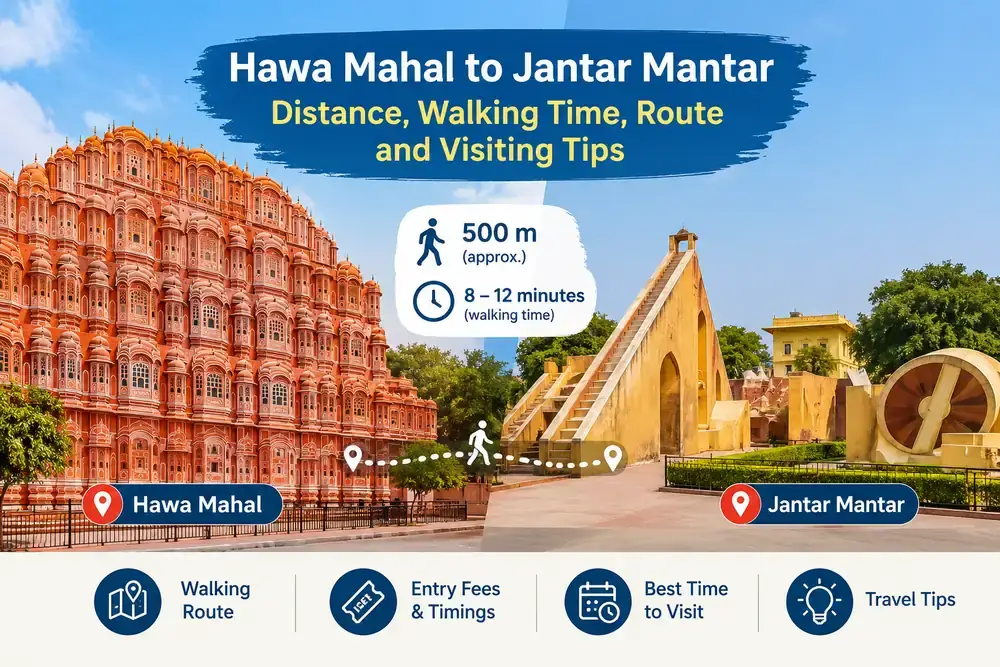

The distance from Hawa Mahal to Jantar Mantar in Jaipur is approximately 500 metres in a straight line. The walk usually takes around 8–12 minutes, depending on your starting point and the route you follow. Both attractions are located in Jaipur’s historic Pink City, making them easy to include in the same sightseeing trip.
Walking is generally the most convenient way to travel between these two landmarks. You can explore the bustling streets of the old city, visit Jantar Mantar near City Palace, and continue your heritage walk without arranging a separate cab or auto-rickshaw.
In this guide, you’ll find the approximate distance, walking route, travel options, entry fees, opening hours, nearby attractions, and practical tips for planning your visit.
Hawa Mahal to Jantar Mantar Distance at a Glance
| Travel option | Approximate distance | Estimated time | Best for |
| Walking | Around 0.5–0.9 km | 8–12 minutes | Most visitors |
| Auto-rickshaw or e-rickshaw | Depends on road route | Around 5–10 minutes | Families and visitors avoiding the heat |
| Taxi or cab | Depends on road route | Around 5–15 minutes or longer | Visitors needing comfortable transport |
Distances and travel times are estimates. Actual road distance and journey time depend on your precise starting point, traffic, pedestrian access, and the entrance you use.
The walking distance may be slightly longer than the straight-line distance because pedestrians must follow the accessible streets and entrances around the historic buildings.
Walking Route from Hawa Mahal to Jantar Mantar
Walking is a practical way to travel from Hawa Mahal to Jantar Mantar. The route takes you through the historic centre of Jaipur, where traditional markets, old buildings and busy shopping streets form part of the experience.
Follow these steps to plan your walk.
- Start at Hawa Mahal: If you plan to visit the interior, enter through the designated rear entrance. The famous pink façade faces the main road, but the visitor entrance is on the opposite side.
- Head towards the City Palace area: Follow the pedestrian route towards Jantar Mantar and City Palace. Check the directions on your map rather than assuming every lane provides direct access.
- Follow the signs to Jantar Mantar: Continue towards the observatory entrance. Jantar Mantar is located beside the City Palace complex in the old city.
- Reach the ticket counter: Once you arrive, check the entrance and ticket arrangements before entering the observatory.
Open walking directions on Google Maps.
Is the Walking Route Easy?
The walk is relatively short, so most visitors can cover it comfortably. However, the old city’s streets can be busy, and some sections may have uneven surfaces, vehicles, street vendors, and crowds.
Keep these points in mind:
- Watch for passing motorcycles, e-rickshaws, and other vehicles.
- Use pedestrian-friendly sections wherever possible.
- Keep your phone and valuables secure in crowded areas.
- Carry drinking water, especially during warmer months.
- Allow extra time during weekends, public holidays and festival periods.
If you’re travelling with someone who has limited mobility, check the pedestrian route and entrance access beforehand.
Travelling by Auto-Rickshaw, E-Rickshaw or Cab
Although walking is usually the easiest option, motorised transport may be more comfortable in hot weather or when travelling with elderly family members or young children.
Auto-rickshaw or e-rickshaw: These may be suitable for a short transfer, depending on vehicle access and the driver’s route. Confirm the fare before starting your journey if the ride is not metered.
Taxi or cab: A cab can provide air-conditioned transport, but the short distance means it may not save much time once pickup, traffic, and drop-off arrangements are considered.
For most visitors, walking is the more practical choice. If you prefer not to walk, check the available drop-off point and the remaining distance to the monument entrance before booking.
Hawa Mahal and Jantar Mantar Timings and Entry Fees
Both attractions are important stops on a Jaipur sightseeing itinerary. Their opening hours and ticket prices should be checked before your visit, particularly because Rajasthan revised monument entry fees from January 1, 2026.
| Visitor information | Hawa Mahal | Jantar Mantar |
| General opening time | Around 9:00 AM | Around 9:00 AM |
| Closing time | 5:00 PM | 7:00 PM, with the last ticket at 6:30 PM |
| Indian adult entry | ₹100 reported for 2026 | ₹100 |
| Indian student entry | ₹50 | ₹50 |
| Foreign visitor entry | ₹600 (₹300 for Foreign Students) | ₹600 (₹300 for Foreign Students) |
| Suggested visit duration | 30–60 minutes | 45–60 minutes |
These are planning references, not a guarantee of the current ticket rates. Confirm the latest applicable fees, concessions, opening hours, and entry conditions before visiting.
Is a Composite Ticket Worth Buying?
Rajasthan offers composite ticket options for selected monuments and museums. The sites covered, prices, and validity depend on the applicable ticket scheme.
Before purchasing one, check whether the ticket covers both Hawa Mahal and Jantar Mantar, how long it remains valid, and whether your other planned attractions are included. City Palace has separate entry arrangements, so do not assume it is included.
A composite ticket may be useful if you’re planning to visit several eligible monuments during your Jaipur trip.
You May Also Like: Hawa Mahal to Nahargarh Fort Distance: Route, Timing & Transport
Which Should You Visit First?
For a comfortable sightseeing experience, start at Hawa Mahal in the morning and then walk to Jantar Mantar. You can continue to City Palace afterwards, as it is located next to the observatory.
Here is a suggested morning itinerary:
| Time | Activity |
| 9:00–9:45 AM | Explore Hawa Mahal and photograph its famous façade |
| 9:45–10:00 AM | Walk towards Jantar Mantar |
| 10:00–11:00 AM | Explore the astronomical instruments at Jantar Mantar |
| 11:00 AM onwards | Visit City Palace, subject to its opening hours and ticket arrangements |
Adjust these timings according to your interests and the current entry schedule.
Why Visit Jantar Mantar in the Morning?
Jantar Mantar is an astronomical observatory built by Maharaja Sawai Jai Singh II. It contains a collection of instruments designed to study celestial positions and measure time.
The Samrat Yantra, its enormous stone sundial, is one of the most recognisable structures inside the complex. Clear weather can help visitors understand how sunlight and shadows are used by the instruments.
If you’re interested in astronomy, architecture or Jaipur’s scientific history, allow enough time to read the information boards or consider hiring a guide.
Places to Visit Near Hawa Mahal and Jantar Mantar
The surrounding old city has several attractions that can be combined with your visit.
| Place | Approximate distance from Hawa Mahal | Why visit? |
| City Palace | A few hundred metres, depending on the entrance | Royal courtyards, museums and palace architecture |
| Johari Bazaar | In the surrounding old-city market area | Jewellery, traditional shopping and local street scenes |
| Tripolia Bazaar | In the historic market district | Traditional crafts, textiles and shopping |
| Govind Dev Ji Temple | Check the route and access from your chosen starting point | Temple architecture and worship |
| Albert Hall Museum | A few kilometres away | Art, historical collections and architecture |
| Jal Mahal | Several kilometres away | Scenic views and photography near Man Sagar Lake |
Distances are approximate and can vary by route and entrance.
Can You Visit City Palace After Jantar Mantar?
Yes. City Palace and Jantar Mantar are next to each other in Jaipur’s historic centre, making them a natural combination for sightseeing.
However, City Palace has its own entry arrangements and visiting schedule. Check the current ticket price and opening hours separately before planning your visit.
Practical Tips for Visiting Both Monuments
- Choose comfortable footwear: You’ll be walking through busy streets and exploring monument grounds.
- Plan around the weather: October to March is generally a comfortable season for exploring Jaipur outdoors, although sunny afternoons can still be warm.
- Carry water and sun protection: A cap, sunglasses, and water bottle can make your walk more comfortable.
- Check tickets in advance: Monument fees and concessions may change, so verify the current rates before travelling.
- Keep shopping flexible: The markets around the old city are worth exploring, but you may need extra time if you stop at shops.
- Respect local customs: Follow posted photography rules and any instructions at religious sites.
- Allow extra time during festivals: Crowds and traffic may increase during major celebrations and busy tourist periods.
- Use an updated map: Pedestrian access and road restrictions can affect the route, so check directions on the day of your visit.
Frequently Asked Questions
1. What is the distance between Hawa Mahal and Jantar Mantar?
The straight-line distance is approximately 500 metres. The actual walking distance may be around 0.5–0.9 km, depending on the route and entrance used.
2. How long does it take to walk from Hawa Mahal to Jantar Mantar?
The walk generally takes about 8–12 minutes. Allow additional time for crowds, road crossings, and navigation through the old city.
3. Can I walk from Hawa Mahal to Jantar Mantar?
Yes. Walking is usually the most convenient option because the attractions are close to each other in Jaipur’s historic centre.
4. Is Jantar Mantar near City Palace?
Yes. Jantar Mantar is beside the City Palace complex, so visitors often explore both attractions on the same trip. Each site has separate entry arrangements.
5. Do I need a cab to travel between Hawa Mahal and Jantar Mantar?
No, most visitors do not need a cab for such a short distance. An auto-rickshaw, e-rickshaw or taxi may be useful if you prefer not to walk.
6. Which should I visit first, Hawa Mahal or Jantar Mantar?
Starting at Hawa Mahal in the morning and visiting Jantar Mantar afterwards is a convenient option. You can then continue to City Palace if time permits.
7. What are the entry fees for Hawa Mahal and Jantar Mantar?
The applicable fees depend on visitor category and the current ticket schedule. Indian adult rates of ₹100 and foreign visitor rates of ₹600 have been reported for 2026, but you should confirm the latest fees through official sources before your visit.
8. Can I visit Hawa Mahal, Jantar Mantar and City Palace in one day?
Yes. These attractions are close enough to combine in one sightseeing itinerary. Allow extra time for the museums, ticket queues, walking, and any additional stops.
9. Is there a combined ticket for Hawa Mahal and Jantar Mantar?
Composite ticket options are available for selected Rajasthan monuments. Confirm the current scheme, validity, and list of included attractions before purchasing. Check City Palace’s ticket arrangements separately.
10. What is the best time to walk between Hawa Mahal and Jantar Mantar?
Morning is generally a comfortable choice, particularly during the cooler months. During summer, try to minimise midday exposure to the sun and carry water.
Final Thoughts
The short distance from Hawa Mahal to Jantar Mantar makes it easy to explore two of Jaipur’s most distinctive heritage attractions in one trip. Walking is generally the simplest way to get between them, and the nearby City Palace makes it convenient to extend your visit into a longer heritage walk.
Check the latest opening hours, entry fees and pedestrian directions before setting out. With a little planning, you can enjoy Jaipur’s architecture, astronomical history and lively old-city atmosphere without spending unnecessary time travelling between attractions.
Sources:
Rajasthan Tourism – Hawa Mahal and Rajasthan Tourism – Jantar Mantar.