
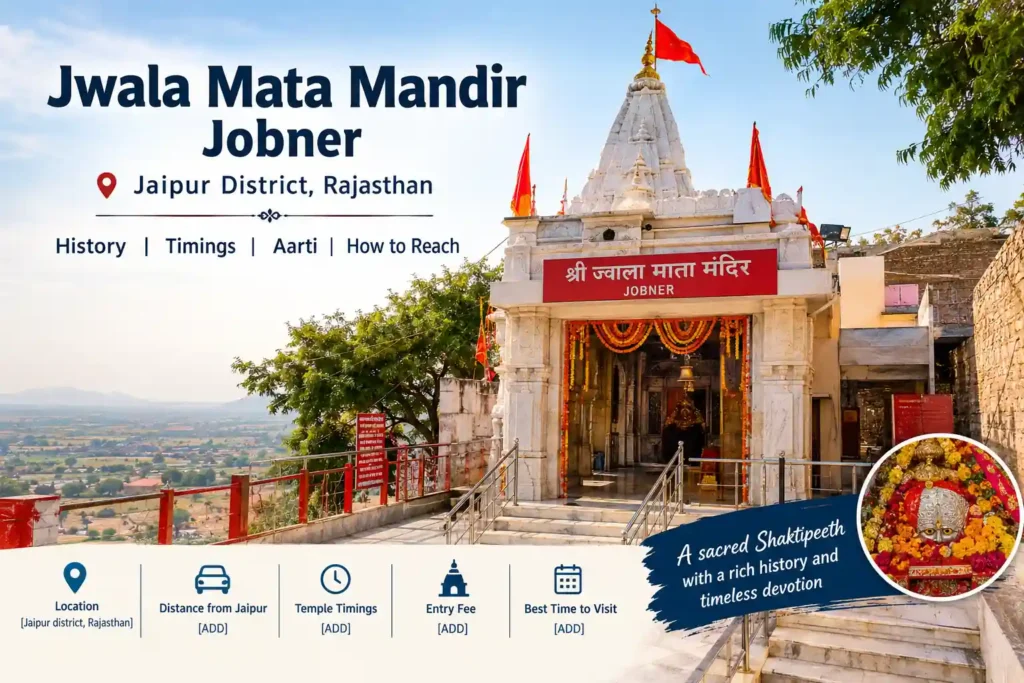

Jwala Mata Mandir Jobner is an important religious place for devotees visiting the Jobner area of Jaipur district, Rajasthan. Also searched as Jwala Mata Temple Jobner Jaipur, the temple attracts visitors who come for darshan, aarti, prasad, and personal prayers.
If you are planning your first visit, it helps to know the practical details before leaving home. This guide covers the Jwala Mata Mandir Jobner history, temple timings, Jwala Mata ki aarti, Navratri, offerings, how to reach the temple, the hill climb, visitor rules, and nearby places.
Quick Information About Jwala Mata Mandir Jobner
| Information | Details |
| Temple name | Jwala Mata Mandir Jobner |
| Location | Jobner |
| District | Jaipur district, Rajasthan |
| Distance from Jaipur | Approx.45 km |
| Distance from Jobner bus stand | Approx.1.8 km |
| Distance from Jobner railway station | Approx.11.1 km |
| Temple timings | Morning (5:00 AM to 1:00 PM) & Evening (2:00 PM to 8:00 PM) |
| Aarti | Morning aarti time is typically around 5:00 AM to 6:00 AM Evening aarti is typically held around 6:00 PM – 7:00 PM) |
| Entry fee | Free |
| Best time to visit | Winter (October to March) & Navratri (April and October/November) |
| Navratri | Opening Time – 3:00 AM Closing Time – 12:00 PM (as soon as all devotees do the Darshan) |
Tip: Temple timings and arrangements can change during festivals or special occasions. Visitors should confirm the latest information locally before travelling.
History and Significance of Jwala Mata Mandir Jobner
The history of Jwala Mata Mandir Jobner is an important part of understanding the temple beyond a simple sightseeing visit.
The history of Jwala Mata Mandir Jobner goes back several centuries and is associated with the Chauhan period of Rajasthan. One of the important historical references connected with the temple is an ancient inscription engraved on a pillar in the temple’s assembly hall.
According to the historical information published by DesiRajasthan, the inscription is dated Vikram Samvat 1022, corresponding to 965 AD, and belongs to the period of the Chauhan ruler Singhraj. The inscription provides an important historical link between the temple site and the Chauhan era and indicates that the religious importance of this place goes back more than a thousand years.
Jwala Mata Temple and the Shaktipeeth tradition
Along with its historical association, Jwala Mata Mandir is also connected with a well-known Hindu religious tradition. According to local and mythological belief, the hill where the temple stands is considered a Shaktipeeth.
The tradition relates the site to the story of Goddess Sati and Lord Shiva. According to the belief, after Goddess Sati’s death, Lord Vishnu used his Sudarshan Chakra to separate her body so that Lord Shiva’s attachment to her would end. It is believed that Sati’s knees fell on this hill, making the site sacred.
The knees of Goddess Sati are therefore believed to be represented and worshipped at this temple. This religious tradition is an important part of the temple’s significance for devotees who visit Jwala Mata for darshan and पूजा-अर्चना.
Development of the temple complex
The temple’s history is also linked with the rulers who contributed to the development of the area. According to the same historical account, the Kachwaha rulers, particularly Rao Khangar, later expanded the temple complex.
Today, the combination of its ancient historical associations, religious traditions and hilltop setting makes Jwala Mata Mandir an important place to include when exploring the religious heritage of Jobner.
Why devotees visit Jwala Mata Mandir
Devotees may visit a temple for different personal reasons, including darshan, prayer, offering prasad or seeking blessings.
Some devotees inform that they came to do the darshan at Jwala Mata when their mannats become true. Devotees do the jagran at night and bhajans.
You May Also Like: Akshardham Temple Jaipur Timings: Aarti, Entry Fee & Visitor Guide 2026
Jwala Mata Mandir Jobner Timings: Opening, Closing and Festivals
Knowing the timings is particularly important if you are travelling from Jaipur or another nearby town.
The regular Jwala Mata Mandir Jobner timings should be checked before starting your journey, especially if you want to attend a particular aarti.
Daily Temple Timings: 5:00 AM–1:00 PM and 2:00 PM–8:00 PM
Navratri and festival timings
During Navratri or other special occasions, the temple schedule may differ from the regular daily routine.
Opening Time : 3:00 AM (In general days, it opens at 5:00 AM)
Mangala Aarti: Morning 3:30 AM to 4:30 AM
Afternoon Break: Between 1:00 PM to 2:00 PM (If the crowd is heavy, the temple close for some time)
Mela Details: During the festival of Chaitra and Sharadiy Navratri, the Lakhi mela occurs for 15 days. If you are visiting the temple during the mela, please try to visit the temple in the early morning at 3:30 AM to 5:30 AM. It will reliev you from the hot days and the crowd.
Visitor note: If you are travelling specifically for Navratri, confirm the schedule locally before leaving because festival arrangements and crowd conditions can change.
Jwala Mata ki Aarti Timings
Aarti is one of the important moments for devotees visiting a temple. If you want to attend Jwala Mata ki aarti, check the daily schedule before planning your visit.
Morning aarti: 5:00 AM – 5:30 AM (Performed right after the temple opens)
Evening aarti: 7:00 PM – 7:30 PM
Festive Morning Aarti: 3:30 AM and 4:30 AM
Name of aarti: “Shree Jwala Mata Ki Aarti” (श्री ज्वाला माता की आरती )
During the aarti, devotees can participate in the worship according to the temple’s local practice.
You May Also Like: Birla Mandir Jaipur Timings 2026: Darshan, Aarti, Entry Fee & Travel Guide
Jwala Mata Aarti
You can see the full video of Jwala Mata aarti through YouTube given below.
Prasad and Offerings at Jwala Mata Mandir Jobner
At this place, devotees worship who worship the Satvik form of Jwala Mata took Prasad of Kheer, Pudi, Nariyal, Chawal, Puye-Pakoudi etc. Those who worship Jwala Mata’s Rudra form, took Mans-Madira.
So, basically, there are two types of bhogs that are Satvik Bhog and Rudra Bhog.
People worship both forms of Jwala Mata here to fulfill their wishes and to take blessings.
Distance from Jaipur and How to Reach Jwala Mata Mandir Jobner
For visitors coming from Jaipur, the distance is short enough for a half-day or full-day trip, but the route and transport options are worth planning in advance.
Distance from Jaipur
Distance from Jaipur: Jobner is roughly 41–47 km from Jaipur by road (most map sources show about 44–45 km, depending on the starting point in the city).
Approximate travel time: About 40–50 minutes by car or bike in normal traffic; about 1 hour 10 minutes if you use public transport with a change.
How to reach Jwala Mata Mandir Jobner by car or bike
Route from Jaipur: There are two commonly used routes. The direct one runs from Jaipur via Jhotwara and Kalwar to Jobner. The alternative is to take the Jaipur–Ajmer highway (NH-48, earlier known as NH-8) and turn off at Mahlan, roughly 22 km from Jaipur, towards Jobner.
Roads and landmarks to follow: For the direct route, head out through Jhotwara, continue to Kalwar and keep following the road signs for Jobner. For the highway route, watch for the Mahlan turn-off and follow the Jobner road from there.
Final approach to the temple: The temple is on a hill at one end of Jobner town, so once you reach Jobner, ask for “Jwala Mata Mandir” or “Jwala Mata ki pahadi” and locals will point you to the base of the hill. The final stretch to the shrine is a climb, so wear comfortable footwear. If you are not sure whether your vehicle can go up part of the way, ask at the base before you start driving up.
How to reach by bus
Bus options from Jaipur: Rajasthan Roadways (RSRTC) runs regular buses to Jobner from the Sindhi Camp bus stand.
City buses to Jobner can also be boarded at Bari Chaupar, Choti Chaupar and Chandpole.
Another option is the city bus (route 24) from Jaipur to Kalwar, followed by a taxi or local vehicle on to Jobner. Jobner is also connected by roadways buses from Ajmer, Sikar and Merta.
Where to get down: Get down at Jobner bus stand, which is in the town centre.
Distance from the bus stop to the temple: The temple is at the edge of town on the hill, a short auto or e-rickshaw ride from the main bus stand. Confirm the exact walking distance with locals, as it depends on which side of the hill you approach from.
How to reach by train
Relevant railway station: Asalpur-Jobner (station code JOB) on the Jaipur–Ajmer section is the nearest station, and most express trains stop here. Phulera Junction (FL) is the other major station, about 16 km from Jobner.
Distance from railway station to temple: The station is roughly 7–10 km from Jobner town (sources vary), and the temple is a little further from Jobner(approx.11 km), at the edge of town.
Local transport from the station: Autos, taxis and shared local vehicles are available for the run into Jobner. Agree on the fare before you start.
Google Maps location
After reaching Jobner town, you can use this google map location to visit the exact location of Jwala Mata Temple.
The Temple Climb: What to Expect on the Hill
If you are visiting Jwala Mata Mandir Jobner for the first time, knowing how the temple is approached can make the trip easier, particularly for senior citizens and families with children.
Temple location on the hill: The temple stands on a hill at one end of Jobner town. The same hill has two old forts and several other temples, and the Mahadev temple sits near the top of the hill close to the Jwala Mata shrine.
Number of steps: The shrine is reached by a stairway up the hill. An official step count has not been published, so it is best to plan for a proper climb rather than a short walk.
Road access: The temple is reached through Jobner town, and the climb begins at the foot of the hill. Whether vehicles can go partway up can change, so ask at the base before you decide.
Approximate time required for the climb: Keep aside extra time. A healthy adult can usually manage the climb at a relaxed pace, while families with children or senior citizens should allow more time, along with a few breaks.
Is the temple suitable for senior citizens and children?
Senior citizens: The route involves stairs and uneven surfaces typical of older hill temples. Senior citizens and anyone with knee or breathing problems should climb slowly, rest often and go with someone who can help. Visiting early in the morning avoids the heat.
Children: Children can make the climb with supervision. Hold young children’s hands on the steps, carry water and avoid the midday sun.
Seating and resting points: Take breaks wherever the stairway levels out. Carry your own water, since facilities along a hill climb can be limited.
You May Also Check: Gopinath Ji Temple, Jaipur: Timings, Watch Mystery, History, Route & Parking (2026 Guide)
Navratri at Jwala Mata Mandir Jobner
Navratri is the most important time of the year at this temple. Jwala Mata Mandir is regarded as an ancient Shaktipeeth.
According to local belief, the knee of Goddess Sati fell at Jobner, and what is worshipped here is the natural knee-shaped form of the goddess. An akhand jyot (continuous lamp) is said to have been burning at the shrine for many years. Thousands of devotees visit during Navratri, and some reports speak of lakhs over the nine days.
Navratri dates and programme: Sharad (Ashwin) Navratri 2026 begins with Ghatasthapana on Sunday, 11 October 2026, and runs to 19 October, with Vijayadashami (Dussehra) on 20 October 2026.
Panchang dates can differ slightly by source, so check the dates for Rajasthan before you finalise your plan. Chaitra Navratri is observed in spring.
Expected crowd level: Expect the heaviest crowds on the first day, on Ashtami and Navami, and on weekends. Darshan queues can be long at these times.
Mela details: The temple becomes a hub of activity during Navratri, with devotees arriving from Jobner and the surrounding villages. Stalls and a festive atmosphere around the temple approach are typical for hill temples during Navratri.
Special darshan and aarti arrangements: During aarti, a traditional naubat (large drum), reported to be about 200 years old, is played at the temple, which gives the aarti a distinctive atmosphere. The temple’s priests belong to the Parashar family. Aarti timings may be extended during Navratri, so confirm them locally.
Parking and traffic arrangements: Jobner’s roads near the hill are narrow, and traffic can build up during Navratri. Park as far from the base as is convenient and walk the rest, or use an auto from the bus stand.
Advice for families and senior citizens: Go early on a weekday if you can, avoid Ashtami and Navami with young children or elderly relatives, carry water, and stay together in the queue.
If you are visiting during Navratri, plan extra time if local authorities or temple management advise that crowds are higher than usual.
Rules, Dress Code and Tips for Visitors
Before visiting Jwala Mata Temple Jobner Jaipur, check the temple’s current rules. Some arrangements may differ on ordinary days and during festivals.
Dress code
No strict dress code has been announced. As at any Hindu temple, modest, comfortable clothing that covers the shoulders and knees is recommended. Wear footwear that is easy to remove and good for climbing steps.
Photography
Photography rules can differ between the approach, the courtyard and the sanctum. Follow the signs displayed at the temple and the instructions of the priests and staff. Avoid taking photos or videos of the idol or of other devotees inside the sanctum unless it is clearly allowed.
Footwear and belongings
Footwear rules: It is customary to remove footwear before entering the main temple area.
Shoe stand or locker facility: Check at the base of the hill for a footwear stand. Keep your shoes with someone from your group if you are unsure.
Bags and belongings: Carry only what you need. Keep valuables to a minimum, especially during Navratri crowds.
Entry fee
No entry ticket has been reported for the temple. Offerings and donations are voluntary.
Other visitor facilities
Drinking water: Carry your own bottle for the climb and top up when you can.
Shade: Shade on a hill climb can be limited. Go early in the morning or late in the afternoon, and carry a cap or umbrella in warm months.
Seating: Rest at the landings along the way and at the temple complex.
Washrooms: Use facilities in Jobner town before starting the climb, as options near a hill temple canbe limited.
Shops: You can found shops selling prasad, puja items and refreshments are usually near the foot of a temple hill, especially on busy days and in Navratri.
Useful tips before visiting
- Check the latest temple timings before leaving.
- If you are visiting for aarti, confirm the aarti time in advance.
- Families travelling with senior citizens should check the hill access and the climb beforehand.
- During Navratri, confirm crowd and parking arrangements locally.
- Carry only the items permitted by the temple.
- Follow instructions given by the temple pujari and staff.
Nearby Places to Visit Around Jobner
If you are travelling to Jobner for Jwala Mata Mandir, you may want to combine your visit with other nearby religious or local attractions.
Mahadev Temple on the hill
A temple of Lord Shiva at the top of the same hill, close to the Jwala Mata temple. Many visitors include it in the same climb.
Approximate distance from Jwala Mata Mandir: On the same hill, a short walk from the Jwala Mata shrine.
Bawri Wale Balaji
A well-known Balaji (Hanuman) temple in the Jobner area, popular with local devotees.
Approximate distance: Within the Jobner area. Ask locally for directions from the hill, as the location is easier to find with a local guide or on Google Maps.
Kalakh Dam Balaji
A Balaji temple near Kalakh Dam (Kalakh Sagar), near Agarpura on the Jobner side of Jaipur district, which people often combine with a short outing to the dam.
Approximate distance: A short drive outside the town. Check the current distance on Google Maps before you plan.
Jobner forts / Heritage places
It has two old forts on the hill beside the Jwala Mata temple. Jobner was historically a thikana (estate) of the Khangarot Kachwaha clan under Jaipur State, and the hill’s forts reflect that history.
Approximate distance: On or beside the same hill as the temple.
Other nearby places
Other temples and sites around Jobner and Agarpura include the Shiv temple, Bhomiya temple and Kalakh Sagar Dam. If you have more time, Asalpur Fort near Asalpur-Jobner station is another heritage stop.
You Can Also Check: Kale Hanuman Ji Jaipur Timings 2026: Aarti, History, Location & Travel Guide
Where to Eat and Stay Near Jobner
If you are travelling from Jaipur or planning a longer visit, food and accommodation can be important practical considerations.
Food options
Jobner is a tehsil town, so you can expect basic dhabas, tea stalls and sweet shops in the main market, usually a short ride from the hill.
For a wider choice of restaurants, many visitors eat in Jaipur before or after the trip. If you are climbing in the morning, carry some water and a light snack.
Stay options
Accommodation options in Jobner are limited. A small number of budget hotels and guest houses are listed online and on travel platforms, but there is no major hotel cluster next to the temple.
Because Jaipur is only about 45 km away, most visitors make it a same-day trip and stay in Jaipur, which has a very wide choice of hotels.
If you want to stay overnight in Jobner, especially during Navratri, book ahead and call to confirm.
Best Time to Visit Jwala Mata Mandir Jobner
The best time to visit depends on what you want from the trip: peaceful darshan, aarti, Navratri celebrations or a family outing.
Best months or season: October to March is the most comfortable period. Summers in Jobner can be extremely hot, and winter mornings can be quite cold, so dress accordingly.
Best time of day for darshan: Early morning is best for a cooler climb and shorter queues, and late afternoon works well for aarti. Avoid the midday sun, particularly between April and September.
Crowd levels on weekdays: Generally calm, with the quietest darshan on ordinary weekday mornings.
Typical crowd levels on weekends: Busier, particularly on Saturdays, Sundays and public holidays, with families visiting from Jaipur and nearby villages.
Typical crowd levels during Navratri and festivals: Heaviest. Expect long queues and traffic around the hill, especially on the first day, Ashtami and Navami.
For a quieter visit, choose a weekday morning outside the Navratri period, and confirm timings locally before you leave.
Conclusion
Jwala Mata Mandir Jobner can be a meaningful stop for devotees and families exploring the religious places around Jaipur district.
Before travelling, check the latest timings, aarti schedule, access conditions and festival arrangements, especially during Navratri. We will continue updating this guide as more temple-verified information becomes available.
If this guide helps with your visit, share it with family or friends planning a trip to Jobner.